Many lodges describe themselves as accessible online, yet travelers with mobility, hearing or vision needs regularly arrive to find stepped entrances, gravel drives and bathrooms with no grab bars in sight. The word “accessible” carries no universal meaning in lodge marketing, which makes lodge accessibility something you have to verify yourself, question by question, before any money changes hands.
This guide walks you through exactly what to ask. We start with what “accessible” actually means at a lodge, then cover questions about the building and grounds, the room itself, how to verify claims before you pay, and smart booking and communication tips. We finish with destination factors that affect accessibility in places like Alaska, the Alps and safari country, plus the bottom line on getting a trip you can plan around with confidence.
What ‘Accessible’ Actually Means at a Lodge
Ask five lodges what “accessible-friendly” means and you will likely get five different answers. Unlike certified hotel rooms, which are often measured against a recognized standard, lodge listings frequently use the word “accessible” as a loose description rather than a guarantee. Nobody is checking, and nobody is defining it for you.
The gaps can be surprisingly small and still serious. A room might genuinely be reachable by elevator, yet sit behind a 2-inch threshold, have a bathroom door too narrow for a wheelchair, or feature a bed frame so high that transferring becomes difficult or unsafe. Each of these details is invisible in a listing photo.
Remote terrain adds another layer
At remote lodges in places like Alaska or the Scottish Highlands, the building itself is often the second hurdle. These properties may be built on uneven, sloping or rocky terrain, which makes the path from your vehicle to the front door the very first barrier you encounter. Ask about that route before you ask about anything else.
Finally, remember that accessibility certifications vary by country. A label that means something in the United States may mean something entirely different elsewhere. Ask directly which standard the lodge is measured against, and if the answer is vague, treat the listing description as a starting point for questions rather than a promise.
Questions to Ask About the Building and Grounds
Your accessible experience at a lodge starts long before you reach your room. The route from car park to front door, and from front door to dinner, determines how independent you can actually be during your stay. A lodge may advertise an accessible room, yet if the parking is on a slope, the path is gravel or the dining room sits up three steps, your freedom shrinks to a single space. These are the questions worth putting to the lodge directly, ideally in writing, before any money changes hands.
The key questions, explained
- Step-free entry and surface: Ask whether the path from parking to the entrance is truly step-free and whether it is paved. Gravel drives and boardwalks are common at remote lodges, and both can be difficult or impossible for wheels, especially after rain. If the surface is loose, ask whether a paved alternative or a ramp exists at a side entrance.
- Van-accessible parking: Confirm there is a van-accessible space with a 96-inch access aisle, and ask how far it sits from the entrance. A suitable space 400 feet away on a slope is a very different proposition than one close to the door, particularly if you travel with heavy equipment.
- Vertical access: If the lodge has multiple floors, ask whether a lift serves them or whether all accessible rooms sit on the ground floor. A lift that stops short of a restaurant level still limits your stay, so map out every floor you plan to use.
- Dining and social spaces: Many lodges place restaurants, lounges and fire pits on raised decks reached by two or three steps. Ask specifically whether each of these spaces is reachable without stairs, since this is where accessible design most often breaks down. Meals are the heart of a lodge stay, and eating in your room every night is not the trip you booked.
- Outdoor access: Clarify whether viewing platforms, fire pit areas and any on-site trails are accessible, or whether the accessible experience ends at the front door. Some lodges offer adapted routes or assistance for outdoor areas, but only if you ask.
Get answers to all five before you book. A lodge that can answer them confidently, with specifics rather than reassurances, is usually one that has genuinely thought about access. Vague replies such as “we can manage” or “most guests are fine” are a signal to keep asking, or to look elsewhere.
Accessibility Questions to Ask About the Room Itself
The room is where vague answers cost you the most. A lodge can describe a room as accessible while omitting the exact measurements that determine whether you can shower, transfer and move around comfortably. Marketing language tends to focus on views and amenities, while the practical details go unmentioned. Ask for numbers, not adjectives, and treat hesitation or generic replies as a signal to keep looking.
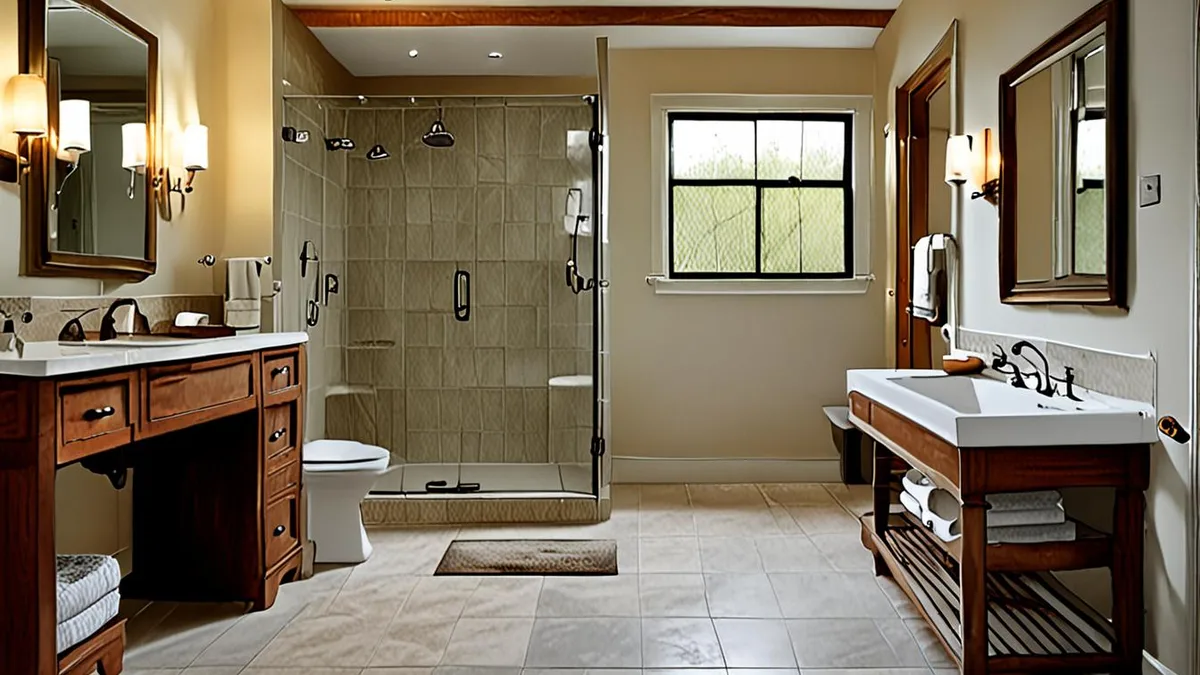
Start with the basics: request doorway widths of at least 32 inches (81 cm) for the room and bathroom doors, and confirm there is a 5-foot turning circle inside both the room and the bathroom. Without that turning space, even a wide doorway will not get you through the stay comfortably. Also ask whether the bathroom door swings inward, since an inward-swinging door can block a wheelchair once you are inside.
Details that make or break the room
- Shower type: Ask specifically for a roll-in shower with a fold-down shower seat and grab bars. A “walk-in” tub is not the same thing, and the two terms get confused constantly in listings.
- Toilet specifications: Confirm the toilet is a comfortable height, in the range of 17 to 19 inches, and that grab bars are mounted beside and behind it.
- Lowered fixtures: Ask whether closet rods, thermostats and peepholes are lowered or otherwise reachable from a seated position. These small omissions add up over a multi-day stay.
- Bed height and clearance: Ask how high the bed is for safe transferring, and whether staff can remove furniture such as an extra chair or luggage rack to widen your clearance around the bed.
- Hearing and vision needs: For hearing access, ask about visual alarms connected to the fire system, vibrating pillow alerts and closed-caption TV. These features exist at some lodges but are rarely mentioned unless you raise them.
Any lodge that can answer each of these points with a confident, specific answer is one that has actually equipped the room, not just labeled it. If the reservations agent cannot confirm measurements, ask to speak with someone at the property who has stood in the room. A short follow-up email summarizing what was promised gives you a written record to reference if anything differs when you arrive.
How to Verify Claims Before You Pay
Marketing photos and a friendly phone call can only tell you so much. Lodges sometimes list rooms as accessible based on a single feature, like a grab bar, while the bathroom door is too narrow to get through. Before you pay a deposit, take a few extra steps to verify that what you need actually exists at the property. Here is how to do it.
- Ask for real photos of the room and bathroom. Request that the lodge email current photos of the exact accessible room, not polished marketing images. Photos of the actual shower, toilet, doorway and bed height tell you more than any description, and they cost the lodge nothing to send.
- Request a video walkthrough of the route. On a call or messaging app, ask a staff member to film a short walkthrough from the entrance or parking area to the room door. This reveals steps, gravel, ramps, thresholds and tight corners that no photo will show. Watch it more than once and note anything you want clarified.
- Talk to someone who has seen the room. A central reservations line may be thousands of miles away and working from the same vague listing you read. Ask to speak with the manager or another staff member who has physically been inside the accessible room and can answer specific questions about clearances and fixtures.
- Get every feature in writing. Once features are confirmed, such as a shower you can roll into with a seat, lift access or accessible parking, ask that each one be listed on your booking confirmation. A written record gives you something to point to if anything falls short on arrival.
- Read reviews from travelers with similar needs. Look for recent reviews on forums and review platforms written by wheelchair users or travelers with comparable needs. Their firsthand accounts often reveal details the lodge itself would never mention, both good and bad.
Each of these steps takes minutes, and together they turn a hopeful guess into a verified booking. Lodges that answer willingly and provide photos and written confirmation are showing you how they treat guests; hesitation or vague replies are just as informative. Do this before any money changes hands, and you will arrive knowing exactly what to expect.
Booking and Communication Tips for Accessible Lodge Stays
Once you have verified that a lodge can genuinely meet your needs, the next challenge is actually securing the room and making sure nothing gets lost between booking and arrival. Accessible rooms at lodges are scarce, communication gaps are common, and small oversights can undo weeks of planning. A few habits make a big difference.
Request the accessible room at the moment of booking, not at check-in. Many lodges have only one or two such rooms, and they are typically the first to go. If you wait until you arrive to ask, you may be offered a standard room with a note that “adjustments can be made,” which rarely means a roll-in shower or adequate turning space.
State all of your needs in writing when you reserve. Include the dimensions of any mobility equipment, such as a wheelchair or scooter, so the lodge can confirm doorways and turning space. If you travel with a service animal, have the lodge confirm its policy in writing at booking, since remote properties sometimes have restrictions on animals that are not mentioned on the website.
Timing and on-site support
For high-season destinations, book three to six months ahead. Accessible inventory is limited everywhere, and in popular lodge regions it can disappear long before standard rooms do. Early booking also gives the lodge time to prepare anything you have asked for, from equipment storage to staff assistance.
Ask what on-site help is actually available. Can staff assist with luggage, help charge a power wheelchair, or explain their emergency evacuation procedure for guests who cannot use stairs? These questions are easy to ask during booking and far better answered then than during a power outage.
Finally, confirm the cancellation terms before you pay. If the room does not match what was promised in writing, you want a clear path to cancel or rebook without penalty. A lodge that resists putting its promises in writing is telling you something important.
Destination Factors That Affect Lodge Accessibility
Even a perfectly equipped room can be undermined by everything around it: the transfer, the terrain, the village itself. Accessibility at a lodge is shaped as much by the destination as by the property, so it pays to think region by region before you commit.
Alaska fishing lodges are a good example. Many are reached by floatplane or small aircraft landing on gravel strips, and neither the aircraft nor the landing area is guaranteed to be accessible. Confirm the transfer separately from the lodge itself, including boarding assistance and any weight or equipment limits on the flight.
Mountains, safaris and historic countryside
Alpine lodges in Switzerland often sit above the village level, reachable only by cable car. A lift-accessible lodge is of limited use if the cable car itself has steps or restrictions, so check the cable car’s access rules as a separate step in your planning. By contrast, ski lodges in Whistler are generally the most accessible mountain option, thanks to a modern, step-free village core that makes getting around between lodge, lifts and restaurants far easier.
For travelers considering Africa, safari camps vary enormously. Many properties now offer adapted game-drive vehicles with lifts or ramps, but only at some camps, so ask camp by camp rather than assuming a whole region or operator is accessible. Our guide to choosing an African safari lodge covers the questions that matter when comparing camps.
Rural lodges in regions like Istria or Gotland often occupy characterful historic buildings, and that charm comes with a trade-off. Thick stone walls, stepped entrances and narrow doorways can limit how much access can be retrofitted. Ask specifically what has been adapted and what has not, since a beautifully restored farmhouse may have no step-free route at all.
The pattern across all these destinations is the same: the lodge is one link in a longer chain. Verify the transfer, the terrain and the surrounding area with the same care you apply to the room itself.
The Bottom Line on Lodge Accessibility
So, how do you avoid arriving at a lodge that claims to be accessible but turns out to have steps, gravel paths and a bathroom without grab bars? The answer is simple: judge the whole journey, not the listing badge. Accessibility at a lodge is only as good as the least accessible link — the parking, the path, the entrance, the room and the bathroom. If any one of those fails, the rest does not matter.
That is why the questions in this guide matter more than any star rating or marketing photo. Written confirmation of specific features beats any listing description, and asking the right questions before booking means you arrive knowing exactly what to expect instead of hoping for the best. A little extra diligence up front can be the difference between a smooth stay and a stressful one. If this guide helped you, leave a comment with your own lodge experiences or share it with a fellow traveler.