Many travelers with mobility needs know the frustration: the booking page said “accessible,” but on arrival the doorway is too narrow, the shower has a high curb, or there’s a step at the entrance nobody mentioned. An accessible label alone tells you almost nothing about whether a room will actually work for you.
This guide to accessible hotels walks you through exactly what to verify before you pay. We’ll look at why booking filters fall short, which room dimensions and bathroom features to confirm, how to check entrances, lifts and distances around a property, and how to time your booking and get every feature in writing. You’ll also find a practical list of questions to ask the hotel directly, so you can book with confidence instead of crossing your fingers at check-in.
Why ‘Accessible’ on a Booking Site Isn’t Enough
When you filter for accessible hotels on a booking site, all you’re really seeing is a checkbox. The filter flags a room as accessible, but it says nothing about door widths, whether the shower is a roll-in or a tub, or how high the bed sits. Two rooms with the same “accessible” tag can be completely different in practice.
Age of the building matters too. Many older European hotels were retrofitted rather than built for accessibility, so a room may be listed as accessible while the entrance still has a single step, or the lift cabin is too small for a wheelchair to turn around in. The room itself might be fine, yet you can’t comfortably reach it.
Why the same wrong description appears everywhere
There’s another trap: third-party booking platforms usually copy their descriptions straight from the hotel. If the hotel’s own text is vague or optimistic, that same wording gets repeated across every platform, so checking a different site rarely gives you a second opinion. The description isn’t independently verified, which is why direct contact with the hotel is the only reliable way to confirm the details that matter to you.
Room Dimensions and Layout to Confirm Before Booking Accessible Hotels
The single most useful thing you can do is ask for measurements in writing. Start with the doorway: in the US, accessible doorways should offer at least 32 inches (81 cm) of clear width, while 90 cm is typical in newer EU builds. If your chair is wide or you use a larger mobility aid, ask for the exact figure rather than accepting “yes, it’s accessible.”
Turning space matters just as much. A wheelchair usually needs a 60-inch (152 cm) circle inside the room to turn comfortably, and a technically accessible room can still be too cramped if furniture eats up that space. Bed height is the third key number: accessible rooms commonly have beds between 45-60 cm high, and what works for one person won’t work for another. When you contact the hotel, ask for photos of the actual accessible room, not stock images of a standard one, since marketing galleries rarely show the real thing.
- Ask if staff can raise the bed or adjust it. Some hotels can add a topper or adjust the frame, which makes a safe transfer possible if the standard height doesn’t suit you.
- Request that furniture be removed before arrival. An armchair, desk or luggage bench can narrow the path; many hotels will move pieces out if you ask in advance.
- Ask where the bed sits relative to the bathroom. A short, straight path from bed to toilet matters more than total room size if you transfer at night.
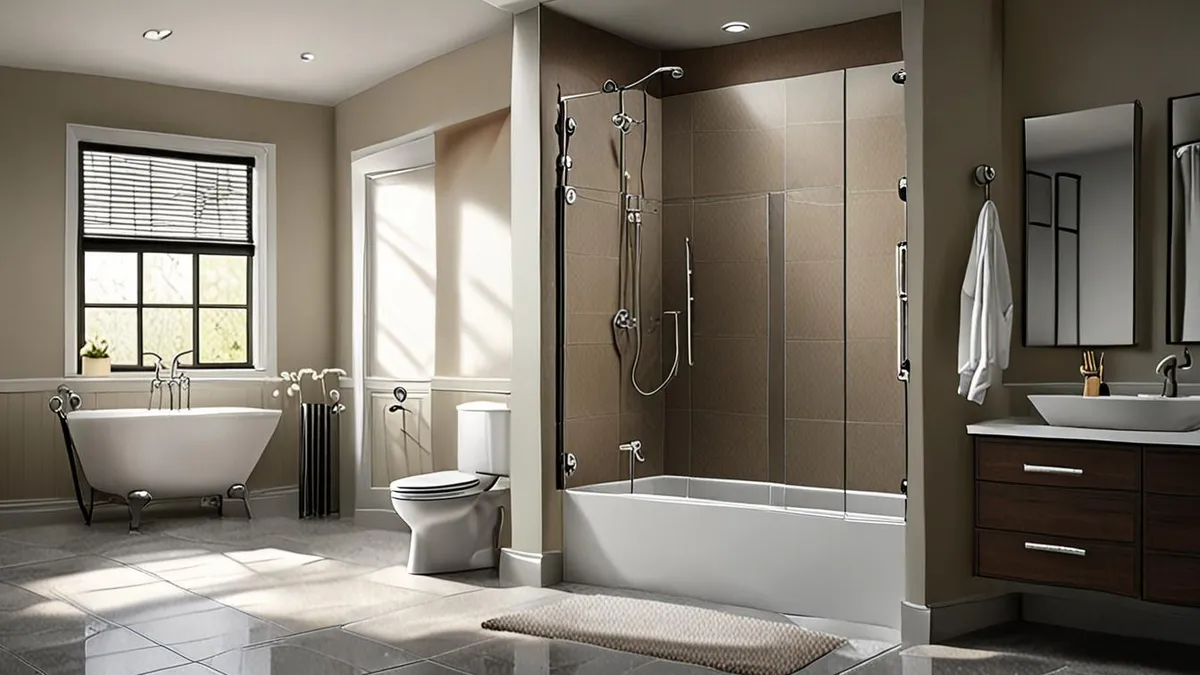
Bathroom Setups: Roll-In Shower vs Grab Rails
The bathroom is where most accessible stays succeed or fail, so get specific here. If you need a roll-in shower, confirm it truly is one: a usable roll-in shower typically needs about 30 x 60 inches (76 x 152 cm) of clear floor space with no curb or threshold to cross. Some hotels list a “walk-in shower” that turns out to be a shallow tub or a cubicle with a raised lip, so ask precisely what the floor looks like.
Then work through the fixtures one by one. Ask whether the shower has a fold-down seat, a handheld showerhead and grab rails positioned at heights you can actually use. Confirm the toilet height, which is typically 45-48 cm in accessible bathrooms, and where the grab bars sit, on one side or both. If you transfer seated, also check the sink: you need clearance underneath for your knees, not a pedestal or cabinet blocking the approach.
- Ask whether the shower seat is fixed or removable. A seat that folds flat against the wall gives you clear floor space when you don’t need it.
- Check the water controls’ position and type. Lever or push taps placed at the entry side of the shower are easier to reach than controls on the far wall.
- Ask if a shower chair can be provided. Some hotels keep portable shower chairs or commodes on hand even in rooms without a built-in seat.
- Confirm the bathroom door swings outward or slides. An inward-opening door can block the doorway if you fall or need assistance inside.
Entrances, Lifts and Getting Around the Property
Even if the room itself is fully accessible, your stay can fall apart at the front door. Some hotels, especially older buildings in Europe, have a step or two at the main entrance with no ramp. Ask the hotel to describe the entrance route in detail, and if the main door has steps, find out whether there is a step-free side entrance and whether it is kept unlocked or staffed during your arrival hours.
Lifts that actually work for you
A lift that exists is not the same as a lift you can use. Ask for the cabin dimensions and whether your wheelchair or mobility scooter fits with the door closed. Also confirm which floors the lift reaches: reception, the breakfast room, the pool level and your room floor all need to be accessible, not just the guest room corridors. In some properties the restaurant or spa sits on a floor the lift skips entirely.
Distances matter too, particularly at resort-style properties. Some spread their buildings, parking lots and pools across 200-500 m of grounds, which can be a long roll over gravel paths or slopes. Ask about the surface and gradient of those paths, and whether an accessible parking spot is reserved and located near the entrance you will actually use, not just the main gate on the far side of the property.
Booking Strategy: Timing and Getting It in Writing
Accessible rooms are a scarce resource, and that scarcity should shape how you book. They usually make up only 3-8% of a hotel’s total room stock, which means they sell out well before standard rooms do, especially in high season. A booking strategy built around that reality will save you from arriving to find your room given away to someone else. The good news is that a few simple habits, applied consistently, take most of the risk out of the process.
- Book 2-4 weeks earlier than you would for a standard room. If you normally book a week ahead, aim for three to five weeks. In high season or at popular destinations, push that even earlier, because the handful of accessible rooms at a property can be gone months in advance. Asking for room measurements in writing at least 2-4 weeks before arrival also gives the hotel time to answer properly rather than rushing a vague reply the night before you travel.
- Get the features confirmed by email. A phone promise means nothing once you arrive. Ask the hotel to email you the specific details you need, such as the doorway width and the shower type, so you have a written record you can refer to at check-in. If the reply is vague or contradictory, that itself is useful information.
- Reconfirm your room assignment 48-72 hours before arrival. Call and email again shortly before you travel to make sure you are still assigned to the accessible room and not bumped to a standard one by an overbooking situation. Confirming by phone plus email in this window sharply reduces the risk of a mix-up, and it also gives you a named contact at the property if anything goes wrong on the day.
- Read the cancellation terms before you pay. If the hotel cannot verify all the features you need in writing, a flexible rate is worth the small premium. It lets you cancel and rebook elsewhere without losing your money if the answers do not add up.
The pattern across all of these steps is simple: build in time and build in proof. Travelers who book early, keep written confirmations and reconfirm before departure rarely face the dreaded arrival scenario of an accessible room that no longer exists. Treat each step as a small insurance policy, and the whole booking process becomes far less stressful.
Questions to Ask the Hotel Directly
Yes/no answers from a reservations desk rarely tell you what you actually need to know. A “yes, we have accessible rooms” tells you nothing about whether your wheelchair fits through the door or whether you can transfer onto the bed. The fix is to ask for numbers, and to ask about the details that never appear on booking sites. A good reservations agent will happily answer specific questions; hesitation or vague replies are themselves useful information. Call during quieter hours if you can, as front desk staff pressed for time tend to give shorter, less accurate answers.
- Exact measurements, not adjectives. Ask for the clear width of the room door, the shower dimensions, the bed height (commonly 45-60 cm in accessible rooms) and the turning space inside the room. Numbers let you compare them against your own chair and equipment.
- Balcony and window access. Ask whether the accessible room has a balcony or terrace you can reach and use independently, and whether the window controls are within your reach. Some accessible rooms have a lovely balcony behind a raised threshold you cannot cross.
- Emergency procedures. Ask whether there is a visual alarm for guests with hearing loss, and what the staff assistance plan is for guests who cannot use stairs if the lift is out of service. A vague answer here is worth taking seriously.
- Housekeeping flexibility. Ask if staff can move furniture to widen paths, raise or adjust the bed, or provide equipment such as a shower chair on request. Many hotels can do all of this, but only if you ask before you arrive.
Framing your questions this way does two things at once. It gets you the real picture of the room, and it signals to the hotel that you know exactly what you need, which usually means better answers and a better-matched room assignment. It also creates a paper trail: if you follow up by email to recap what was promised, you have something concrete to reference at check-in. Keep your notes from the call in the same place as your booking confirmation, so whoever handles your arrival can see exactly which room you were promised and why.
Booking with Confidence
Arriving at a hotel labeled ‘accessible’ only to find a step at the door or a bathtub where you expected a roll-in shower is a frustratingly common experience. The word ‘accessible’ on a booking site is a starting point, not a guarantee. The dimensions, bathroom setup and property layout are what actually determine whether a room works for you, and those details are worth verifying yourself before you pay.
The good news is that a little preparation goes a long way. Book early, since accessible rooms make up a small share of most hotels’ stock and sell out first in high season. Get the key features confirmed in writing, and reconfirm your room assignment by phone and email 48-72 hours before arrival. Direct questions to the hotel give you the real picture that booking filters never will. If this guide helped you, share it or leave a comment with your own booking tips.