Picture the photos: a polished silver Airstream glowing in a meadow at sunset, string lights twinkling, a fire pit crackling nearby. It looks like a boutique hotel on wheels. But airstream and trailer glamping is still a trailer stay, and many guests arrive surprised by how much that changes things. Space is tight, storage is minimal, and a private bathroom is far from guaranteed.
This guide walks you through what these stays are actually like once you arrive. We cover how pitches are laid out, what the inside of a trailer really offers in terms of sleeping and storage, how shared bathrooms and camp kitchens work, and why the season you pick matters more than it would at a hotel. We also break down typical prices and booking windows, plus a practical checklist to run through before you pay. Read it and you’ll arrive prepared rather than puzzled.
What an Airstream or Trailer Pitch Looks Like on Site
Most airstream and trailer glamping sites don’t cram units into rows like a campground. Instead, trailers sit on fixed pitches scattered through a meadow, an orchard or a woodland clearing, typically spaced 5-15 m apart. That spacing gives you a sense of privacy you won’t find at a busy RV park, though you’ll still hear neighbors chatting on a still evening.
The better sites go a step further and park each trailer on its own gravel or decked pad. A setup like that usually comes with a picnic table, a fire pit and two dedicated parking spots, so you’re not circling for a space or balancing dinner on your knees. Not every site works this way, so look at photos of the actual pitch rather than just the trailer itself.
Hookup or off-grid: the question that shapes your whole stay
Before booking, find out whether your trailer sits on a full hookup pitch or an off-grid one. A hookup pitch gives you power, water and sewer connections, which means reliable lighting, heating and often air conditioning. An off-grid pitch runs on solar panels and propane, which is atmospheric but limits what you can run at once.
Layout also depends on the site’s size. Vintage trailers are often placed as single statement units on small sites with just 3-10 units in total. Expect a quiet, low-density feel where the trailer itself is the main attraction rather than one option among dozens.
Inside the Trailer: Space, Sleeping and Storage
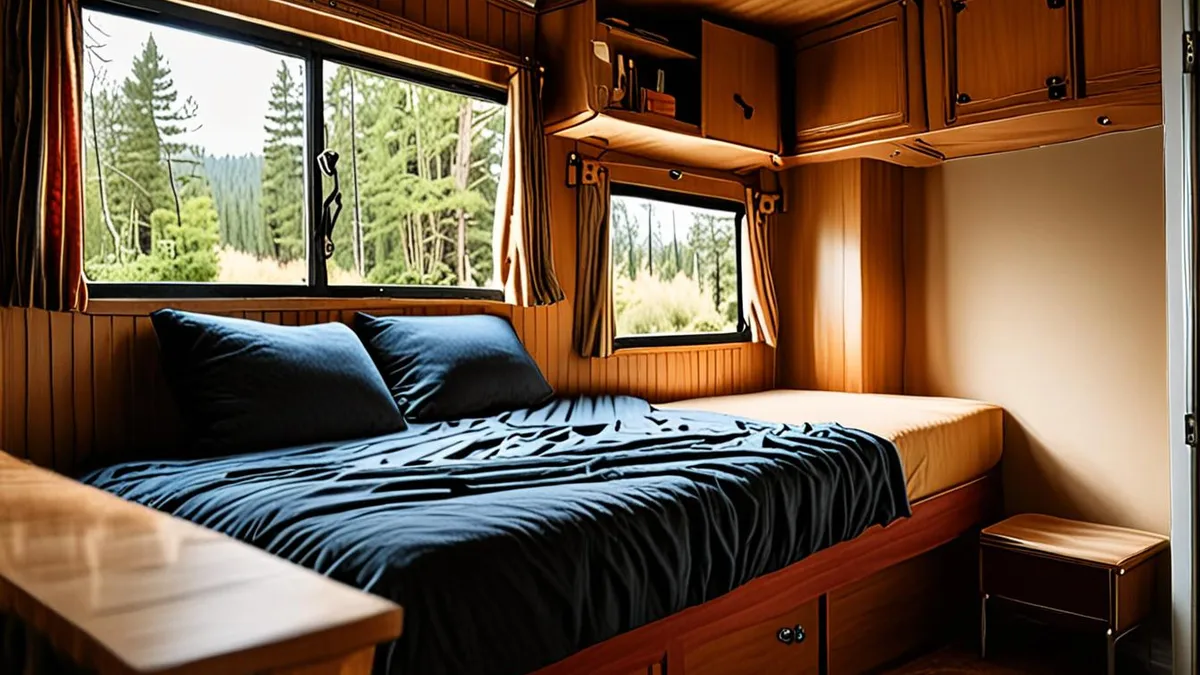
The first thing most guests notice when they step inside a classic trailer is how compact it feels. A classic Airstream is only about 2.1-2.5 m wide, so corridors are narrow and two people can’t easily pass each other. Headroom drops noticeably under the curved ceilings, and older models are tighter still, so tall guests will spend the stay slightly stooped.
Sleeping arrangements: who sleeps where
Most trailers sleep 2-4 guests. The typical layout is a fixed double bed at the rear or front, plus either bunks, a convertible dinette or a compact sofa bed. That works well for couples or small families, but check the exact configuration before booking if you’re four adults, because a converted dinette mattress is not the same as a real bed. Traveling with a pet adds another layer of planning, so it makes sense to read up on what to check before glamping with a dog before you commit to a compact space like this.
Storage: pack soft, pack light
Storage means a small wardrobe, a few drawers and some overhead nets, and that’s about it. Hard-shell suitcases are genuinely awkward here; they don’t fit under beds or in overhead spaces, and they end up blocking the narrow walkway. Soft duffel bags that squash into gaps work far better. Pack for three or four days rather than a fortnight, or plan to leave most of your luggage in the car.
Interiors vary enormously between units. Some are fully restored in retro-chic style with a proper wet room, while others keep their original 1960s-70s fittings and have no private bathroom at all. Read the unit description closely, because two trailers on the same site can offer very different levels of comfort.
Shared Facilities: Bathrooms, Kitchens and Cooking
A large share of vintage trailers have no private bathroom, so your morning routine happens in a shared shower block typically 20-100 m from your pitch. These blocks usually have toilets, hot showers and sinks, and on small sites of a handful of units you’ll rarely queue. On larger sites, mornings and evenings after a full day of arrivals can be busier, so a torch for the walk and a bit of patience help. If you want a broader picture of how shared facilities work across different types of sites, what to expect from bathrooms and kitchens at a glamping site covers the basics.
Inside the trailer, cooking usually means a two-burner propane hob, and there is rarely an oven. Many sites add a communal or covered camp kitchen with a fridge, hob, sink and basic cookware, which covers the meals you simply can’t make on a two-burner stove. At the pitch itself, an outdoor grill is often the other option, and grilling under the stars is half the point of the stay anyway.
What’s provided varies widely between vintage-trailer sites, so confirm the essentials before you go:
- Bedding and towels: some sites make beds fresh for arrival, others expect you to bring a sleeping bag or linens, and a few charge a linen fee as an add-on.
- A starter kit: coffee, salt, pepper and dish soap are sometimes waiting on the counter, but on other sites you’ll be making a supermarket run on day one.
- Cookware and utensils: communal kitchens usually have basic pots and pans, but a sharp knife, a cutting board or a corkscrew is not always part of the deal.
- Cleaning expectations: some operators ask guests to wash up and sweep before checkout, which matters if you’re leaving early for a flight.
A quick message to the site before booking settles all of these in one go, and it also tells you a lot about how responsive the hosts are.
How Season and Weather Change a Trailer Stay
Metal Airstream shells are beautiful but they conduct heat fast. Parked in direct sun, a trailer can feel like an oven by mid-afternoon, which makes July and August the toughest months for a trailer stay. The good news: units on full hookups typically have air conditioning, so you can close the blinds and cool down. Off-grid pitches running on solar and propane may only offer a fan, so check which type of unit you are booking before a summer trip.
If you have flexible dates, aim for the shoulder months. May, June and September usually give you warm days, cool nights for sleeping and noticeably thinner crowds at the site. You still get long evenings outside, but the trailer itself stays far more comfortable through the afternoon.
Cold weather in a vintage trailer
Winter trips work best on hooked-up units, where propane heaters keep the interior genuinely warm. Vintage trailers have thin, single-skin walls, though, so expect chilly edges around windows and corners, plus a fair bit of noise when wind and rain hit the metal shell. If you want a head start on packing and planning, our guide to staying warm while glamping in winter covers the essentials.
One last thing to expect: condensation. In cold weather, moisture collects on the metal walls, especially when you are cooking or sleeping with windows shut. Sites know this, and most provide ventilation tips and extra blankets rather than double glazing, so crack a window at night and use the covers they give you.
What Airstream and Trailer Glamping Costs and How to Book
Trailer glamping sits in the mid-range of the pricing scale. In the United States, expect roughly $120-$300 per night, and in Europe around €100-€230. A beautifully restored Airstream with a private wet room will usually sit at the top of each range, while simpler vintage units on off-grid pitches come in lower. Treat these as typical figures and check current rates with the site, since they shift with season and demand.
Timing matters as much as the unit you pick. For May-September weekends, book 2-3 months ahead, because small sites with only a handful of trailers fill up quickly. If your dates are flexible, midweek stays in the shoulder season are often 20-30% cheaper than the same unit on a summer weekend.
Before you pay, confirm exactly what the rate includes. On vintage-trailer sites in particular, some basics are treated as add-ons rather than part of the deal:
- Linens and towels: some sites make the beds for you, others charge a linen fee or ask you to bring a sleeping bag, which changes both your budget and your packing list.
- Firewood: many sites sell bundles on site or include a starter supply, so ask whether the fire pit is usable out of the box or needs a purchase.
- Parking: a second car space is sometimes included, sometimes charged per night, which matters if you travel as a pair of couples.
- Hookup power: on pitches with electricity, some operators meter it or add a flat utility fee, especially for air conditioning use in summer.
Also expect minimum-stay rules of 2-3 nights on summer weekends and holiday periods. These are common on small sites, so build them into your itinerary rather than planning a one-night stopover in peak season.
Practical Checks Before You Go
A few quick questions before you book will save you surprises on arrival. The most important one concerns beds: ask for the exact configuration, the headroom in the sleeping areas and whether the dinette actually converts. This matters most if you are more than two guests, because a “sleeps four” trailer often means one proper double plus a snug dinette or compact sofa bed that suits kids better than adults.
Packing is different for trailer stays too. Hard-shell suitcases are awkward in a narrow corridor with limited storage, so soft bags are the practical choice; they slide into the cupboards and under the bed far more easily. Bring a torch for the walk to the shower block, which can be 20-100 m away on sites without private bathrooms, and pack layers, since metal interiors cool down quickly at night even when days are warm.
Connectivity is the other thing to manage expectations about. Metal trailer bodies block phone signal, and rural sites often have weak Wi-Fi at best, so check coverage before assuming you can work or stream from the pitch.
- Arrival windows: small sites are often run by a resident owner who meets you personally, so confirm check-in times and what happens if your ferry or flight runs late.
- Access lanes: trailer pitches sometimes sit down narrow farm tracks where large vehicles or motorhomes cannot pass, meaning you drop luggage at a car park and walk the last stretch.
- Pitch orientation: if you are sensitive to heat, ask whether your unit sits in shade or full sun through the afternoon, since that changes how the metal shell behaves.
- Site layout: with only a handful of units on most vintage-trailer sites, ask which pitch you are getting if you want privacy from the communal kitchen or shower block.
Wrapping Up Your Trailer Glamping Trip
Airstream and trailer glamping is charming, but it is not a hotel room on wheels. Expect a compact space for 2-4 guests with limited storage, narrow corridors and reduced headroom, and in many vintage units no private bathroom at all. Shared shower blocks, two-burner stoves and soft bags instead of suitcases are simply part of the experience.
Comfort also depends heavily on the season and the pitch. Hooked-up trailers handle summer heat and winter cold far better than off-grid units running on solar and propane. Budget $120-$300 per night in the US or €100-€230 in Europe, book 2-3 months ahead for peak season weekends, and verify the bed configuration, facilities and exactly what the rate includes before paying. If you have stayed in a retro trailer lately, share how it went in the comments.